

What growing companies often underestimate about time, productivity, and delayed hiring decisions.
For many growing companies, hiring employees starts as something leadership simply handles internally.
A role opens up. A job gets posted. Applications start coming in. Managers review resumes between meetings and try to fit interviews into already packed calendars.
At first, the process feels manageable.
But as organizations grow, the conversation around hiring manager vs recruiter often becomes much more important than companies initially realize.
That is because hiring employees internally often becomes far more time consuming and operationally disruptive than expected.
At Lakeside HR Group, we regularly work with companies that initially planned to manage hiring entirely in-house, only to realize later that the process was pulling significant time and energy away from the rest of the business.
The challenge is rarely effort. The challenge is bandwidth.
Nicole Peterlin Schnell, SHRM-CP, Senior HR Consultant at Lakeside HR Group, explained that many companies underestimate how much coordination and ongoing attention hiring actually requires.
“Reviewing applications, actively interviewing candidates in a well-rounded way, scheduling candidates with leaders can be really tricky. It’s a lot of effort to try and coordinate between busy calendars,” Peterlin Schnell said. “You’re trying to make sure that you’re getting candidates in in a timely manner.”
That time commitment impacts far more than HR.
It impacts leadership, operations, department managers and the employees carrying additional workload while positions remain open.
Hiring Manager vs Recruiter: Where the Process Starts Changing
One of the biggest differences in the hiring manager vs recruiter conversation is how much time and focus each side can realistically dedicate to the hiring process.
Hiring managers are balancing:
- team leadership
- client responsibilities
- operations
- project deadlines
- employee management
Recruiters, on the other hand, are focused specifically on sourcing, screening and managing the hiring process itself. That distinction becomes increasingly important as organizations scale and hiring needs become more specialized.
Many companies initially assume hiring employees internally will save time or money. But the hidden operational costs often build quietly in the background.
Open Roles Eventually Affect the Entire Team
One of the biggest hidden costs of handling hiring internally is the operational pressure created when a role stays open too long.
At the beginning of a search, most companies are focused on finding the best candidate. But over time, priorities often shift. Projects continue moving. Deadlines remain. Existing employees absorb additional responsibilities. Managers step in to fill gaps wherever they can.
Eventually, the pressure of the open role starts affecting the entire organization.
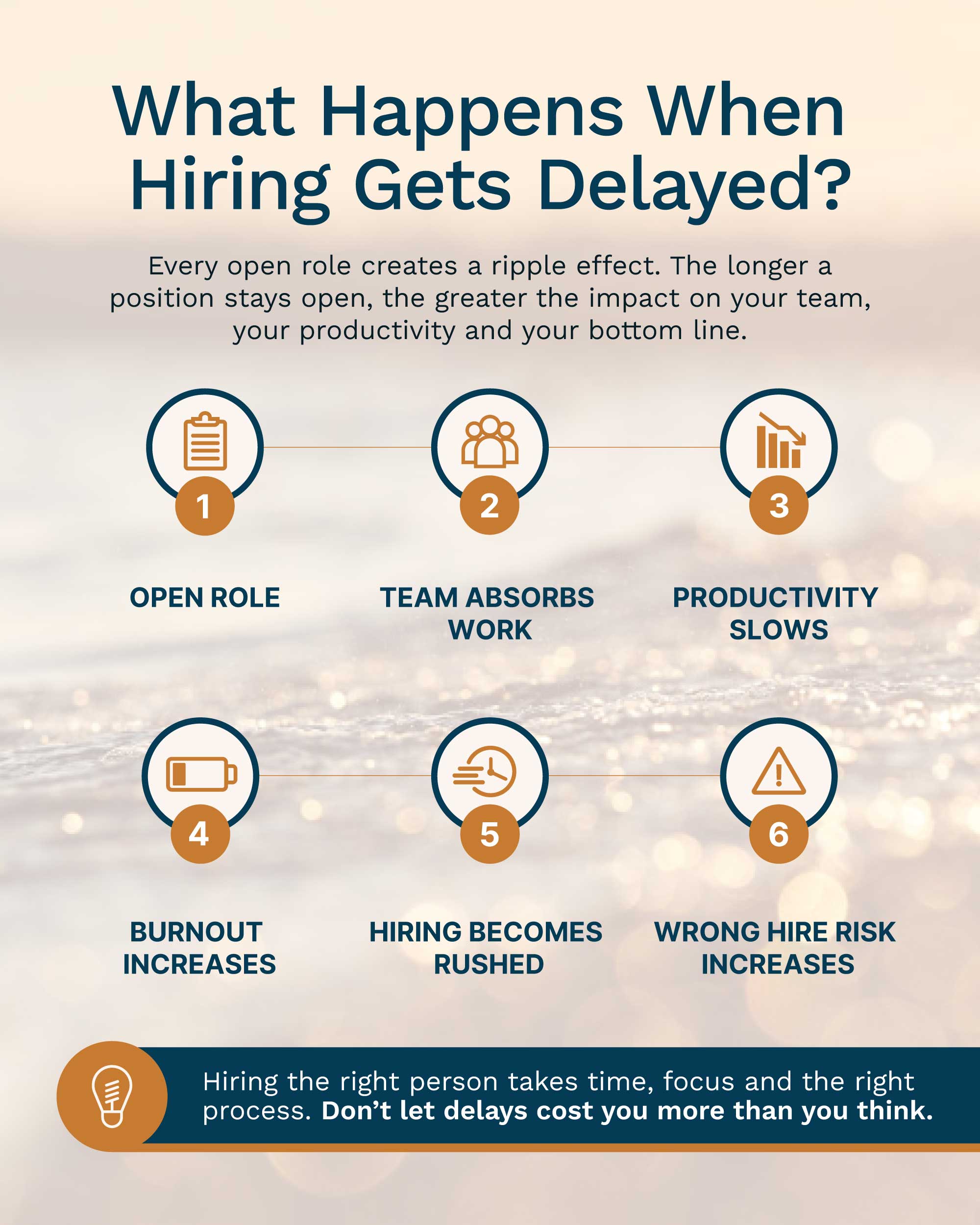
When a key position opens up, the work doesn’t disappear. Existing team members often step in to cover the gap, taking on additional responsibilities while trying to keep everything moving forward.
As workloads increase, productivity begins to decline, stress rises, and burnout becomes a real concern. The longer the role remains open, the greater the pressure to hire quickly, increasing the risk of making a rushed hiring decision.
Hiring Employees Internally Requires More Resources Than Most Companies Realize
Recruiting is rarely just posting a job and waiting for the right person to apply.
There are compensation conversations. Resume reviews. Scheduling coordination. Screening calls. Internal feedback meetings.
Offer discussions. Candidate communication.
All of it requires time from people who already have full-time responsibilities.
Angie Fischer, Senior Recruiter at Lakeside HR Group, said companies often do not realize how much internal energy hiring consumes until they are already deep into the process.
“They’ve posted the role out there. They’ve gotten way more applicants than what they were expecting. And now there’s somebody internally that’s taking the time to go through each and every one of these candidates,” Fischer said.
That workload compounds quickly.
In many growing organizations, hiring employees becomes one more responsibility layered on top of operations, leadership, client management and day-to-day business priorities.
Hiring Manager vs Recruiter: Access to Passive Candidates
Another major difference in the hiring manager vs recruiter discussion is access to candidates.
Many organizations handling hiring internally rely heavily on inbound applicants. But for specialized or leadership roles, the strongest candidates are often not actively applying.
“A lot of times people are looking for a job when they need a job versus being open to a new opportunity even though they’re not actively looking,” Fischer said. “That’s our job as an outside agency recruiter, to go out and find those candidates and have those initial conversations.”
That outreach process is especially important for leadership and hard-to-fill positions where industry experience matters.
Many experienced professionals are successful where they currently are. They are not spending time refreshing job boards every day. That does not mean they would not consider the right opportunity. It simply means someone needs to initiate the conversation.
Learn more about how passive candidate recruiting works and why many of the strongest candidates are not actively applying to jobs.
Recruiting Is About More Than Filling a Seat
The pressure to fill an open position quickly often pushes companies toward reactive hiring decisions. Over time, the focus shifts from finding the right long-term fit to simply getting someone into the seat.
“Finding the right candidate is digging in a little bit deeper,” Fischer said. “Above and beyond the resume, where does that skill set stand? What’s going to make somebody successful in this position?”
That type of evaluation takes time. It requires conversations, industry understanding and consistent communication between recruiters and hiring teams. It also requires the ability to look beyond surface-level resumes and understand transferable experience, leadership style and long-term alignment.
Recruiting Is About More Than Filling a Seat
The pressure to fill an open position quickly often pushes companies toward reactive hiring decisions. Over time, the focus shifts from finding the right long-term fit to simply getting someone into the seat.
“Finding the right candidate is digging in a little bit deeper,” Fischer said. “Above and beyond the resume, where does that skill set stand? What’s going to make somebody successful in this position?”
That type of evaluation takes time. It requires conversations, industry understanding and consistent communication between recruiters and hiring teams. It also requires the ability to look beyond surface-level resumes and understand transferable experience, leadership style and long-term alignment.
Recruiting Support for Growing Companies
Whether your organization is navigating growth, struggling to fill specialized roles or simply trying to create more bandwidth internally, Lakeside HR Group partners with companies to support long-term hiring success.
Related Recruiting Resources
About Lakeside HR Group
We are a premier Recruiting and HR Consulting firm connecting people and businesses through personalized, full-service solutions. As a boutique firm of seasoned HR professionals, we specialize in providing customized HR services for small to midsize businesses. With expertise across diverse industries, positions, and states throughout the U.S., we partner with our clients to discover top talent and deliver the support needed to help their businesses thrive.