
When Leadership Support Becomes Most Critical
When people hear “team building,” they often think of offsites, exercises, or the occasional trust fall. Most teams aren’t built in those moments.
Team building opportunities are built into the day-to-day, in how expectations are communicated during one on one meetings, how conflict is handled, and whether people feel safe enough to speak up when something isn’t working. Often, it’s not those everyday moments that test a team. It is when something shifts.

What happens to a team when a long-tenured employee leaves? A new personality joins the mix? Tension surfaces that have not needed to be addressed before? Suddenly, the question becomes: how do we get back to alignment?
This is where ongoing leadership support becomes critical, helping teams navigate those moments with more clarity and confidence.
Stability Can Mask a Lack of Structure
We have had a number of conversations recently with leaders of small, close-knit teams. These are teams that genuinely enjoy working together and take pride in their company culture. But when something changes, many find themselves navigating unfamiliar territory.
In growing businesses, long tenure and strong relationships can create a sense of stability. What sits underneath that stability is not always clearly defined. Shared expectations, consistent processes, and a clear approach to navigating change are often informal or untested. When those moments come, even strong teams can feel the impact.

How Team Dynamics Are Impacted in Small Businesses Without Dedicated HR
Nearly half of small businesses operate without a dedicated HR function, leaving people-related decisions to leaders already balancing multiple roles. That does not mean the need for HR goes away. It simply shows up differently, often requiring more strategic, efficient approaches to people support.
In Small Business HR Solutions: Maximizing Efficiency with Limited Resources, we break down how growing teams are navigating this shift.
Where Gaps Begin to Show
Leaders are balancing business priorities while also trying to support their people well. Managers are navigating feedback, conflict, and communication in real time, often without a playbook. Employees may not have a clear, neutral place to go when questions or concerns arise.
Work still exists. The support is just not always clearly defined.
Over time, this can quietly shape team dynamics at work in ways that are not always immediately visible.
This is where many organizations are beginning to think differently about how they provide that support. Not every business needs a full-time HR hire, but many benefit from having a consistent resource who understands their business, their culture, and their people.
At Lakeside HR Group, this is the space we step into every day. Through fractional hr and as-needed HR consulting support, we partner with organizations to provide that consistent presence, supporting leaders in real time while also offering an objective perspective to guide decisions and strengthen the team over time.
What the Data Shows About Team Dynamics At Work
86% of employees cite lack of collaboration or ineffective communication as the primary cause of workplace failures
Teams that communicate effectively can increase productivity by up to 25%
Only 2 in 10 employees strongly agree that their performance is managed in a way that motivates them to do outstanding work
Sources: Salesforce, McKinsey & Company, Gallup
These patterns often reflect gaps in how teams are supported day to day. Without consistent leadership support, even strong teams can begin to lose clarity, connection, and momentum.
How Leadership Support Shows Up in Strong Teams
Leadership support shows up in the day-to-day in ways that are easy to overlook, but meaningful when they are consistent.
In practice, this often looks like:
These are not large interventions. They are small, consistent actions that shape how a team experiences work day to day.
Over time, this is what strengthens team dynamics at work and builds trust across the team.
The Two Gaps That Cause Teams to Struggle
When a team is navigating change or tension, two gaps tend to show up quickly, especially in the absence of leadership support.
The Capability Gap
The first is a capability gap. Many managers were promoted because they are great at what they do, not because they have been trained to navigate people challenges. Giving feedback, addressing conflict, and resetting expectations are not always intuitive skills, and they rarely come with a clear playbook.
The Perspective Gap
The second is a perspective gap. There is often not a neutral, consistent voice helping guide those moments. When everyone is inside the situation, it can be difficult to see it clearly. Decisions can feel personal, conversations can get avoided, and culture, while still important, becomes harder to actively protect.
3 Reasons Leadership Support Gets Delayed
In many organizations, leadership support is not intentionally avoided. It is often delayed.
There is a belief that strong teams will work through challenges on their own. That existing relationships will carry through moments of change. That things will settle without needing to be addressed directly.
Sometimes they do. Often, they do not.
- 1
Early signals are easy to dismiss
A shift in communication, a missed expectation, a conversation that feels unresolved. - 2
Leaders are balancing competing priorities
Business needs move quickly, and people challenges get pushed to the side. - 3
There is no clear ownership of the issue
Without a defined support structure, it is not always clear who steps in.
Over time, these moments compound.
What might have been a simple conversation becomes a larger reset. What felt manageable becomes more complex.
This is often where ongoing leadership support changes the trajectory. Not by stepping in only when something breaks, but by helping teams navigate earlier, when the path forward is still clear.
The Role of Support
A Different Model of Support
The strongest teams are not just made up of capable individuals. They are supported by people and systems that help them navigate the hard moments well.
This is often the role leadership support and HR is meant to play. Not just policies or compliance, but supporting leaders, guiding conversations, creating consistency, and helping ensure that both the business and its people are moving forward together.
In many growing organizations, that support does not always need to sit inside the business.

Rethinking Where Team Support Comes From
We are seeing more organizations rethink how they support their teams, especially during periods of growth or change. It may not be a full-time internal hire or a role that sits neatly within the org chart. But having a consistent, experienced partner who can support leaders in real time, provide an unbiased perspective, and help navigate the moments that matter, strengthening leadership support across the organization.
At Lakeside, this is the space we step into every day. Not to replace leaders, but to support them. We bring experience to guide teams through people challenges and the objectivity to do it in a way that strengthens the team over time.
Strong teams are not defined by how long they have worked together, but by how well they navigate change together.
Continuing the Conversation
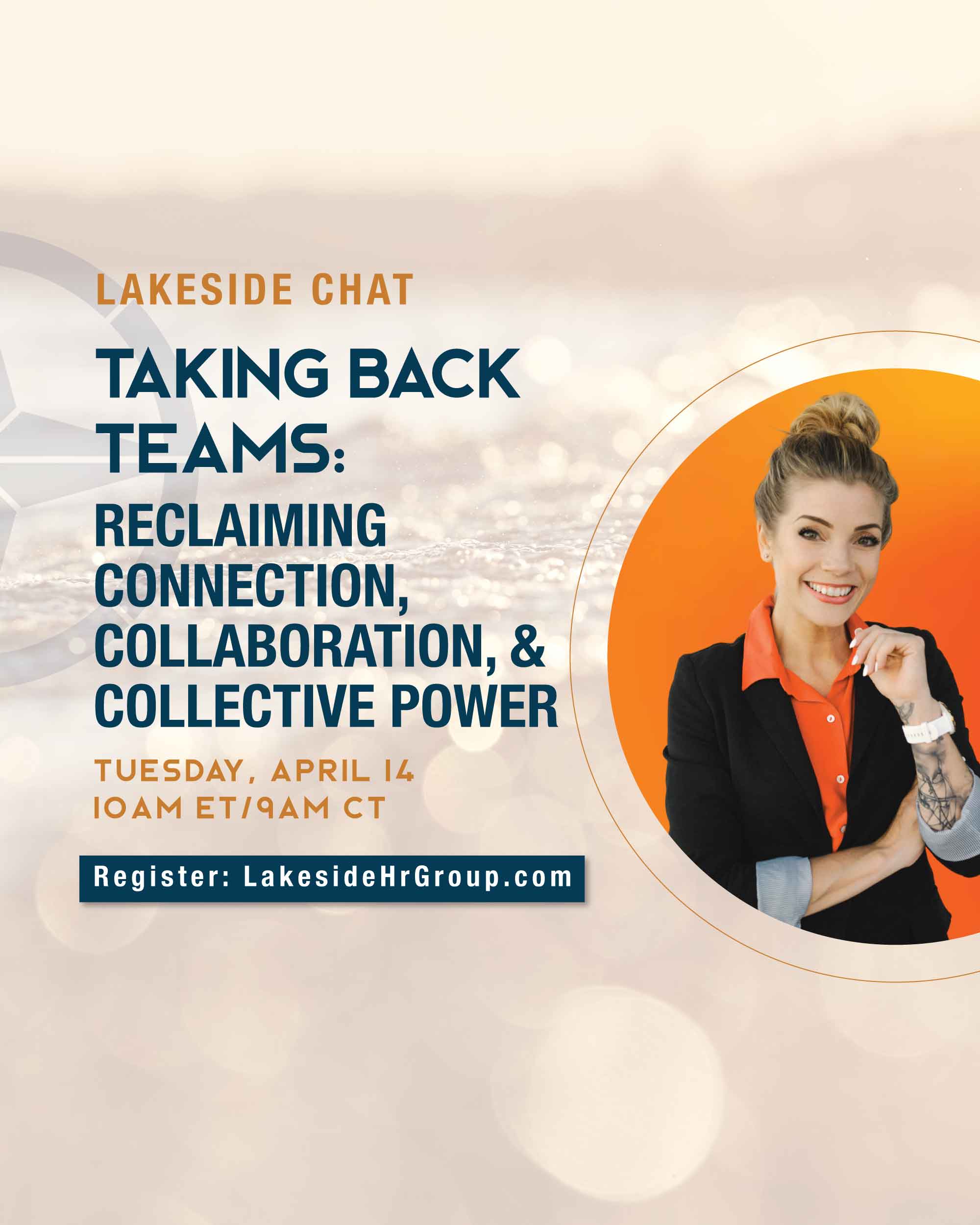
This is exactly the kind of conversation we are excited to explore in our upcoming Lakeside Chat webinar “Taking Back Team: Reclaiming Connection, Collaboration, & Collective Power” with Sarah Line of Boredroom Breakouts
Join us Tuesday, April 14 at 9am CT to dig deeper into what it really means to lead teams well.
Building a strong team is not just something you schedule, and it is not something that happens by chance. There are moments when it is important to step away from the work, to be intentional, to reset, and to invest in how the team works together. There are also the everyday moments, how decisions are made, how feedback is shared, and how safe people feel speaking up, that shape the team just as much.
Strong teams are built in both places, with intention and over time.
About Lakeside HR Group
We are a premier Recruiting and HR Consulting firm connecting people and businesses through personalized, full-service solutions. As a boutique firm of seasoned HR professionals, we specialize in providing customized HR services for small to midsize businesses. With expertise across diverse industries, positions, and states throughout the U.S., we partner with our clients to discover top talent and deliver the support needed to help their businesses thrive.