

With Erin Hargrove, Director of Business Development at Lakeside HR Group
As AI Changes Hiring, the Human Side Becomes More Important
AI is changing how people find jobs, how employers evaluate talent and what organizations expect from employees. But the human decisions behind hiring and how to lead people through these changes are becoming more important, not less.
The labor market is creating questions from nearly every direction.
Job seekers are wondering why they can apply for dozens of positions and hear nothing back. Employers say they still cannot find the right people. Organizations are trying to determine when outside recruiting support makes sense. And educators are asking how to prepare the next generation for a workplace that is changing faster than anyone can predict.
Recently, Lakeside HR Group’s Erin Hargrove and Amy Toppen had the opportunity to facilitate a workshop for the Minneapolis Regional Chamber’s Community Externship Program, which gives educators real-world employer insights they can bring back to their students.
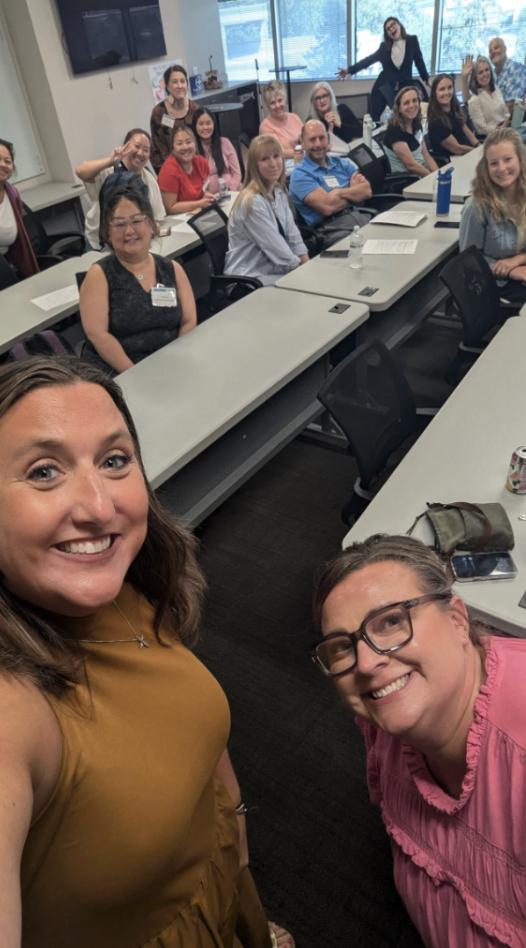
Erin Hargrove and Amy Toppen of Lakeside HR Group with educators participating in the Minneapolis Regional Chamber’s Community Externship Program.
Over the course of the workshop, the group explored resume reviews, workforce expectations, industry-specific hiring needs and the skills that translate across careers. The conversation also raised an important question:
How do we prepare the next generation of employees to enter a workforce that continues to change?
For Erin Hargrove, Director of Business Development at Lakeside HR Group, the conversation reinforced something much bigger about today’s labor market.
Everyone is trying to adapt at the same time.
Candidates are changing how they find jobs. Employers are reconsidering what they need from employees. AI is reshaping recruiting and the work itself. Employees are being asked to develop broader skill sets. And HR leaders are navigating all of it while the rules continue to change.
So perhaps the better question isn’t simply, What is happening in the hiring market?
It’s what do employers, employees and candidates need to do differently because of it?
The conversation with educators offered a firsthand look at both sides of workforce preparation: what students are being prepared for today and what employers expect them to know when they enter the workforce.
The discussion also raised a bigger question: How do we prepare students for careers that will continue to change as technology, AI and workplace expectations evolve?
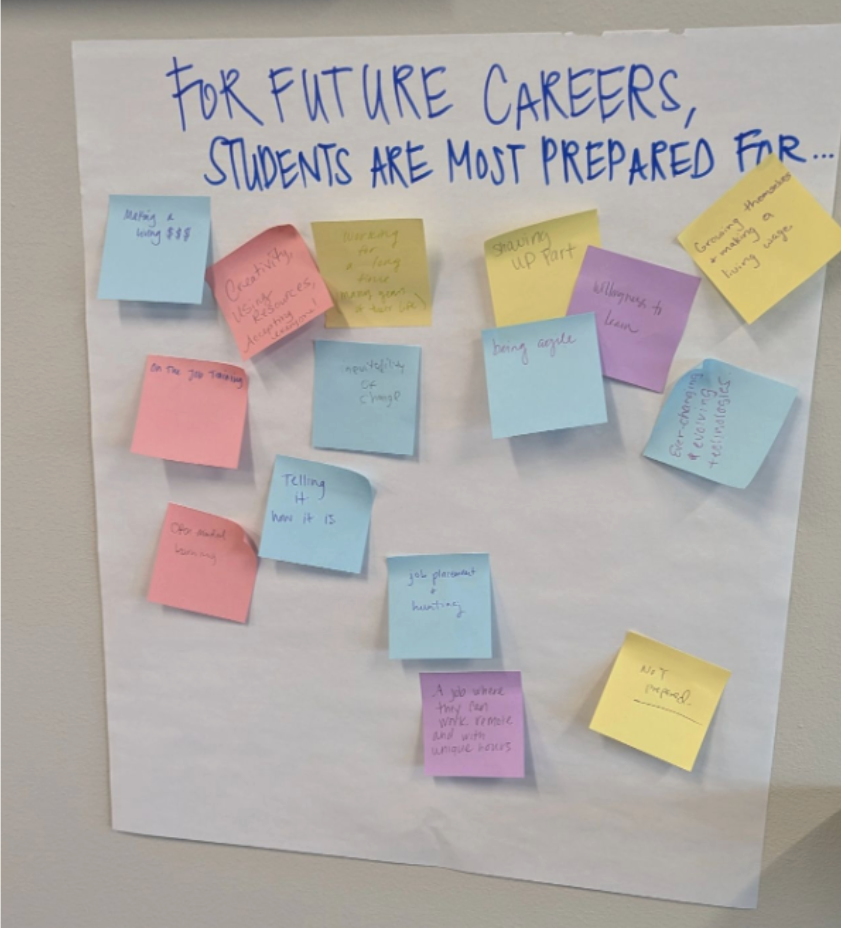
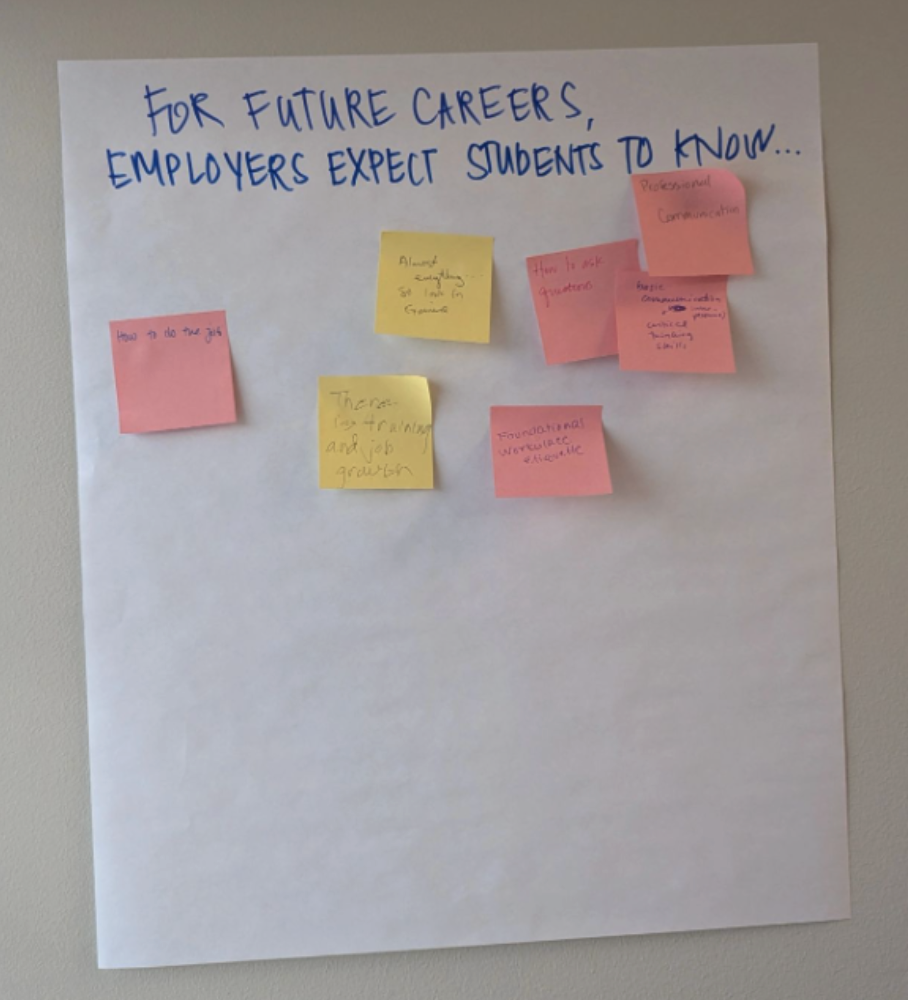
During a recent workshop with educators, Lakeside HR Group explored the skills students are developing today alongside the skills and capabilities employers are looking for in the future workforce
The Skill We Cannot Afford to Lose: Curiosity
As the group considered which skills will best prepare students for a changing workforce, Hargrove kept coming back to one: curiosity.
“We cannot possibly teach students every system or technology they will encounter during their careers. We do not even know what some of those tools will be yet,” said Hargrove. “Teach them to ask questions. Teach them how to learn. Teach them to be curious. That will always be needed.”
That lesson extends well beyond students.
Today’s employees are being asked to learn new systems, incorporate AI into their work and continually adapt as jobs themselves evolve. Technical skills are important, but the ability to learn, adapt and stay curious may be just as valuable as the knowledge someone brings to the role today.
For employers, that may also require reconsidering what they look for in a candidate.
Does someone need experience with your exact system? Or have they demonstrated an ability to learn new systems quickly? Do they check every box today, or do they have the curiosity and adaptability to grow into what the position may become tomorrow?
AI Is Reshaping the Job Search, But a Candidate’s Network Remains Powerful
Technology is also changing how candidates and employers find one another.
Candidates can use AI to customize resumes around individual job descriptions. Employers are increasingly using AI-enabled tools to help manage recruiting, review applications and screen resumes.

SHRM reports that 51% of organizations use AI to support recruiting activities, with 44% using it for tasks related to reviewing or screening resumes.
As Erin puts it:
“We have AI-generated resumes increasingly talking to AI-enabled recruiting systems,” Hargrove explained. “AI talking to AI.”
Yet one of the most effective ways to get noticed remains decidedly human: relationships.
Erin believes that makes professional relationships and personal connections even more valuable.
“Who knows you? Who can speak to how you work? Who can make an introduction?” she said.
In a hiring environment where employers may receive a high volume of increasingly polished applications, professional relationships and referrals can provide something technology cannot easily replicate: context.
A resume tells an employer what someone says they can do. A trusted relationship can help demonstrate how that person actually works.
Job Changes Are Not Necessarily the Problem
Employers are also navigating changing expectations around flexibility, work-life balance and career longevity.
Candidates today may have more movement on their resumes than previous generations, but Erin believes the number of moves alone does not tell the full story.
“Changing jobs is not necessarily the problem,” Hargrove said. “Being unable to explain why you moved, what you learned and what you were moving toward can be.”
For candidates, that means being prepared to tell the story behind their career decisions.
For employers, it means looking beyond tenure alone and understanding the progression behind a candidate’s experience.
A career path does not have to be perfectly linear to demonstrate growth, commitment or value.
Employers Want Broader Skills, But Are Slower to Commit
On the employer side, another tension is emerging. Organizations want greater efficiency. They want employees who are comfortable with technology. They are looking for broader skill sets and, in some cases, combining responsibilities that may previously have existed across multiple positions.
At the same time, employers appear increasingly cautious about making hiring decisions.
Economic uncertainty may be part of it. Compensation and overall employment costs may be part of it.
Hargrove sees another layer of uncertainty emerging for employers.
“Employers are asking whether they really need to replace a position exactly as it existed before,” she said. “At the same time, they may be wondering how much of what they are seeing through resumes and interviews truly represents the candidate.”
All of this can make an open position look more straightforward from the outside than it actually is.
Is Time-to-Fill Still the Right Question?
Hiring data reflects some of this complexity. Depending on the positions being measured and where an organization starts the clock, time-to-fill data can tell very different stories.
That uncertainty has led Hargrove to question whether one of the most common recruiting metrics tells the whole story.
“Maybe this is not just a time-to-fill conversation anymore,” she said. “Maybe it is a motivation-to-fill conversation.”
It is an important distinction. A position can remain posted for weeks or months, but that does not necessarily mean an organization is prepared to hire.
“How badly does the company need someone? What happens if the position remains open? Is leadership prepared to make a decision when the right person comes along? Is the compensation aligned with what they are asking someone to do?” Hargrove asked. “An open job does not necessarily mean an employer is motivated to fill it.”
For hiring leaders, those questions are worth answering before beginning a search.
If an organization has not aligned internally around the need for the role, compensation, responsibilities and decision-making process, adding more candidates to the pipeline may not solve the underlying problem.
Employees Are Navigating Moving Targets Too
The pressure is not limited to job seekers and hiring leaders.
Existing employees are being asked to become more efficient, learn new technology and, in many cases, take on responsibilities that once belonged to multiple roles.
Hargrove described the experience for employees as a series of continually changing expectations.
“Learn this system. Now learn this one. Figure out how AI can make you more efficient. Keep proving your value while the definition of efficiency itself continues to change,” she said. “They are moving targets.”
That environment has implications for more than productivity.
It affects employee development, performance expectations, job design, retention and leadership.
If an organization expects employees to continually adapt, leaders also need to consider whether they are giving people the training, communication and support necessary to do it successfully.
HR Is Sitting in the Middle of All of It
Perhaps that is what makes this moment in the workplace feel so different.
The pace of change is accelerating across nearly every part of the employee experience.
Technology is changing.
Data is changing.
Compliance requirements evolve.
Policies need to keep pace.
Recruiting practices are changing.
Employees are learning new ways to work.
Candidates are learning new ways to compete for opportunities.
Even educators are reconsidering what future employees need to know before they ever enter the workforce.
For Hargrove, that constant change is ultimately what puts HR at the center of the conversation.
“Employers are figuring it out. Employees are figuring it out. Candidates are figuring it out. Educators are trying to figure out what they should teach the people coming next,” she said. “And HR is sitting right in the middle of all of it.”
That does not mean HR needs to have every answer.
It does mean HR has an increasingly important role in helping organizations ask better questions, make thoughtful decisions and keep the human impact of change from getting lost in the technology.
Leading People in an AI Workplace
That intersection between technology and people is exactly what we will explore during our next Lakeside Chat, AI in HR 2.0: Leading People in an AI Workplace.
Our first AI conversation focused on the arrival of artificial intelligence in the workplace. This time, we are taking the conversation one step further:
How do we lead people through it?
On Tuesday, August 25, Dr. Charryse Johnson and Lakeside HR Group’s Vana Greischar will explore both the human impact of AI and its practical application inside organizations.
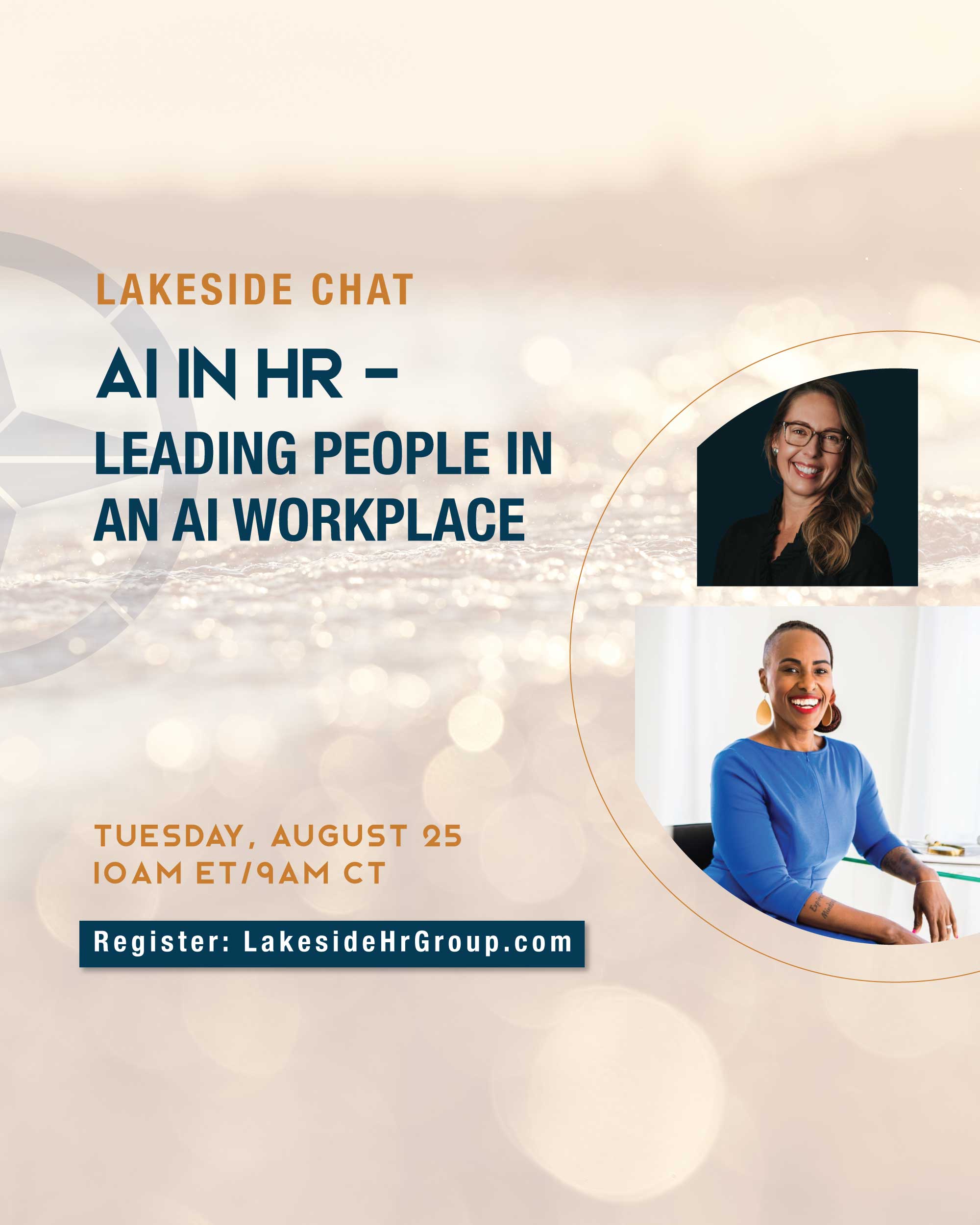
On Tuesday, August 25, Dr. Charryse Johnson and Lakeside HR Group’s Vana Greischar will explore both the human impact of AI and its practical application inside organizations.
Because AI is no longer a standalone workplace topic.
It is part of the recruiting conversation. The employee conversation. The leadership conversation. The compliance conversation.
And, as Erin’s recent conversation with educators demonstrated, it is now part of the conversation about how we prepare the people who will enter the workforce next.
Learn more and register for AI in HR 2.0: Leading People in an AI Workplace.
About Lakeside HR Group
We are a premier Recruiting and HR Consulting firm connecting people and businesses through personalized, full-service solutions. As a boutique firm of seasoned HR professionals, we specialize in providing customized HR services for small to midsize businesses. With expertise across diverse industries, positions, and states throughout the U.S., we partner with our clients to discover top talent and deliver the support needed to help their businesses thrive.